Background Photo

Background Image: Lambs sheep by Jon Sullivan
Showing posts with label facebook. Show all posts

Sunday, 25 March 2012

The Girl in the Community Service Learning Program

<><>
Julian Agyeman Speaker Series 2012.
L. Hegberg (personal collection. March 23,2012)
<><> <><>
Sustainability Summit Discussion 2012.
L.Hegberg (personal collection. March 23, 2012)


Community Service Learning has been a great opportunity for me to get more involved with the organization I volunteer with, Sustain SU at the University of Alberta. ALES 204 is a class where I have learned how to use and put to use social media. I have learned how to be more effective with promotion and outreach for Sustain SU in regards to social media, specifically, on Facebook and Twitter. In ALES we were taught how to effectively search for people and organizations on Twitter and Facebook.This knowledge allowed me to go on Twitter and search for other campus sustainability organizations around the world. Connecting with similar organizations has been important to me for information, outreach and awareness purposes. I was able to compile a network of over seventy campus sustainability organizations and look at the ways they network with their followers (Twitter) and how they are successful in encouraging talk about sustainability. American University’s Office of Sustainability Twitter account had included us in their “#FollowFriday” shout-out tweet; I really like how they used recognition to thank the people that had chosen to follow them. I set out with a similar desire in mind, to recognize people who followed our account, and started “#WelcomeWednesday”. This is one of many things I was able to learn by properly using Twitter as a way to find similar users.


From Twitter, by L. Hegberg
(Personal Collection. March 23, 2012)
<><>
Sustainability Summit 2012.
L.Hegberg (personal collection. March 23,2012)
Another role I was able to take on as a CSL volunteer was profiling, talking about and covering/attending sustainability or students union events. In ALES we learned that Twitter is an effective platform for promotion and conversation for events, people in one room can be connected together on Twitter given a specific hashtag or organization alias, (@uasusustain) for instance. I like fellow classmates blog post Confessions of a Twitter Skeptic because Brenda talks about the challenge of putting her thoughts into 140 characters. She says tweeting has allowed her to become more concise and to lose unnecessary words. I will use one of my tweets to explain how effective 140 characters can be.


From Twitter, by L. Hegberg (Personal Collection. March 23, 2012)
“Goodmorning! Happy #WorldWaterDay! Check out the UN site, link here. @water What positive effect will you have on water use today?”
In ALES I learned effective ways to encourage conversation and help inform our followers.

1.  The Hashtag: #. When I hashtag WorldWaterDay, I use no spaces so it is seen as one entity, this way when someone looks at our tweet they can click on the hashtag “#WorldWaterDay” and Twitter will compile tweets and users that have used the same hashtag in their tweet, and people can explore other people who are all talking about World Water Day.
2.   I added a link; a good, informative, working link is imperative if you want your followers to look further into what you are talking about. Links make information accessible.
3.   I directed the tweet. Directing a tweet involves adding someone’s Twitter alias to your tweet, in the example above I directed it to the user, “@water”, which is an organization on water. This directs users to the place where I may have gotten the information or to a place I feel is relevant. Directing also notified the user “@water” that I have mentioned him in my tweet, and they may retweet our tweet, spreading the word even further.
4.   I asked the question, “What positive effect will you have on water use today?” to encourage followers to reply to us and think about the question. If they reply, the tweet will be directed at us, “@uasusustain” and then people that follow them will be able to click on our alias and see what our organization is about.
The University of Alberta webpage regarding Community Service Learning states that
"through CSL:
  • Students gain invaluable experience and develop personal, professional, and intellectual skills;
  • Community partners gain the energies and capabilities of students and have the opportunity to be co-educators;
  • Instructors gain an enlivened classroom, new perspectives on pedagogy, and links with community organizations."
Taking part in the CSL program with the help of our ALES instructors has helped me learn how to use social media to help raise awareness and encourage the community to become informed and get involved with non-profit organizations such as Sustain Students Union. I believe that that the organization and myself have gained the three things stated in the goals of CSL. I have gained experience in social media and communication, Sustain SU received a helping hand in their organization, and my CSL opportunity allowed me to make more connection to class.


References:
What is Community Service Learning (CSL)? (2012) Retrieved from http://www.csl.ualberta.ca/


Written by: Lina Hegberg
TA: Shannon Clarke
Lab: H8

Wednesday, 22 February 2012

The Accessibility of Sustainability; How Two Universities Have Incorporated Social Media Into Student and Community Life

What role does social media play in the accessibility of sustainable practice?

When I first became involved with sustainability on campus, I had no idea what sustainability meant. I felt like “sustainability” was so broad, that it seemed impossible to comprehend what it exactly was. I describe sustainable practice as protecting tomorrow, by assessing and making appropriate changes to what we are doing socially, economically and environmentally today. Learning how to make sustainable choices is relatively easy but not everyone knows this nor does everyone have the means to practice this. So what is one solution? Where would we find over 750 million people in one place? Jeff Bullas (2011) tells us that “1 in every 13 people on Earth is on Facebook” and that “in March 2011 there were an estimated 225 million [Twitter] users”.My fellow classmate Lauren states that "communication in general is crucial in all aspects of life. Both professionally and personally. Learning how to communicate through social media and other online resources is something that I believe is becoming increasingly important as our world continues to become more technologically oriented". This statement reminds me of how imperative it is for an organization to be utilizing social media to increase awareness and inform their community. In class Dr. Lacetti spoke about how Twitter can be used effectively for business in Lecture 6, so I will assess the institutions use of Twitter. In Lecture 13, Lacetti also highlighted the importance of proper presentation, so I will be looking at how the institutions present themselves on their webpages. (Lacetti, 2012) I want to take a look at two different Universities and the social media platforms they use (Facebook, webpage, and Twitter) and see what they do that makes them successful. This will also give me the opportunity to see good ideas and implement them in the organization I volunteer for.


Trend List on Twitter. From L Hegberg (Personal Collection, March 2012)


Office of Campus Sustainability at the University of Ottawa, Canada
Founded in 2006,The Office of Campus Sustainability collaborates with the Sustainable Development Committee to find ways to make knowledge and ways to act sustainability accessible to students and the university community. The Office of Sustainability (2011) states that “as Canada’s university, we believe we have a leadership role to play in the education, research and policy setting necessary to ensure the sustainable development of our planet, our nation, and our community.” I first came upon them through their Twitter account,@uOttawaSustain which: keeps followers informed about sustainable acts on campus, recognizes campus sustainability ambassadors, educates with good links, and most importantly engages their followers by replying to tweets and mentioning other users. Moving on from Twitter, I clicked on the link provided in their Twitter bio, which I would have liked to see take me to the website. It took me to their “follow me” account, so I had to do some of my own digging to find their webpage. Would someone normally take an extra step to find out more,or move on? Regardless, the website I found was great. In my ALES 204 class I learned about how presentation greatly affects a viewer’s choice to continue enjoying content or to leave. When I reached this, I was excited to navigate the website with ease,and be linked quickly to their other social media platforms. As you can see below, tabs indicate a host of possibilities to explore their sustainability efforts, under the tab “Get Involved” I clicked a link which told me about “Green Reps” and “EcoNetworks”, which work to involve students on campus and students in their respective workplace environments. On Facebook all their posts are vibrant and eye-catching,which may be the reason 461 people like it. It is important that posts be brief and easy to read. The idea of the initial post is to attract attention and encourage people to read more. I deemed their attempts successful upon seeing comments and “likes” are scattered generously across the page.
Homepage for UOttawa's Office of Campus Sustainability, Screenshot. L Hegberg. (Personal Collection, April 2012)
The Office of Sustainability at American University, Washington, DC
The welcoming messages states that “American University is committed to acting on our values through social responsibility,service, and an active pursuit of sustainability. Our work at the Office of Sustainability celebrates the abundance of nature by building a campus community of leaders who work to clean our air and water, cool our atmosphere, and produce fertile land and habitat. We invite you to use this Website to learn how you can get involved and join our journey to sustainability” (2012). I think their invitation to get involved was well received. I first found them through Twitter, @GreenAU, where I found one idea I loved: #FollowFriday, they give “shout-outs” to a few of their latest followers.I liked it so much that I incorporated it into my own campuses sustainability Twitter account (@uasusustain) as #WelcomeWednesday. I found their webpage easy to navigate. I can click on a small link and it leads to bigger and more informative places, encouraging me to explore until my eyes are too sore to see clearly. The only problem I could find was the placement of their social media links, which was at the bottom of the webpage. When I found their Facebook page, I found a great technique to engage people, they incorporated current events to connect with peoples interests and help them think about these things in terms of sustainability. I was excited to implement this for Sustain SU, and have done so with things like elections all the way to the Grammy's.

Screenshot of American University's Office of Sustainability Webpage. L Hegberg. (Personal Collection, March 2012)

My assessment: have they done their part in making sustainability accessible?
ALES 204 taught me how to properly present information: using good color contrast, quality pictures, proper citations, and making information easy to find and navigate. ALES 204 also taught me how to find institutions with similar values by searching on Twitter, and I was able to look at different organizations and critically analyze their ideas and strategies for reaching out to their community. I only looked at two institutions but was happy to have done so, the ideas that these institutions have incorporated into their pursuit of accessible sustainability have encouraged me to further integrate similar things into my work. I was happy to find a host of information scattered across a variety of social media platforms. I was able to find information about what sustainability means to them, their future plans, current projects they’re working on and how I could get involved. Both institutions have done a good job making knowledge about sustainability accessible and as a result have increased awareness, interest and participation. With the collaborative work universities are doing, they are making sustainability a tangible object that their community can work with and see results. This makes me think a sustainable future is absolutely possible. Through my Community Service Learning volunteer position at Sustain SU and my time in ALES 204 I was able to take the knowledge from class and experiences outside of class and apply them to my social media account. This made me a stronger communicater and a better student.
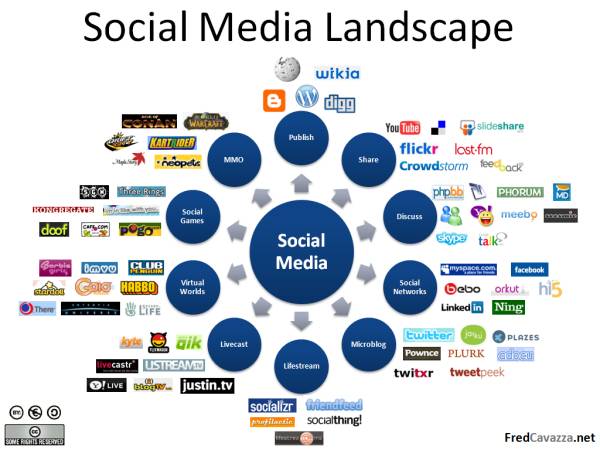
Social Media Landscape. From fredcavazza (2008). Retrieved April 2, 2012 from Flickr: http://www.flickr.com/photos/fredcavazza/2564571564/

Extra Things to Think About:
Is the implementation of social media (and all the technology required) sustainable?
What would the world look like right now if social media was non-existent?
Has social media made us more productive?

What opportunity costs are associated with social media use?

References:

J Bullas. (2011) 50 Fascinating Facebook Facts and Figures.Retrieved from Jeff Bullas Webpage.
J Bullas. (2011) 30 Terrific Twitter Facts and Figures. Retrieved from Jeff Bullas Webpage.
University of Ottawa (2011). Resources - Sustainability 101. Retrieved from Office of Campus Sustainability Webpage.
University of Ottawa (2011). About Us, General Section. Retrieved from Office of Campus Sustainability Webpage.

American University (2012). Sustainability Home. Retrieved from The Office of Sustainability at American University Webpage.

By: Lina Hegberg
TA: Shannon Clarke
Lab: H8

Thursday, 26 January 2012

Facebook Page, The New Resume?

Facebook ScreenShot by ellesheepberg

   Facebook Screenshot, From ellesheepberg (2011) Retrieved from Flickr http://www.flickr.com/photos/75301849@N06/6769204687/in/photostream

I want to share a personal story about how I came to understand the importance of having an accessible, professional "resume" for people interested in your work. With today`s focus on social media and with a majority of people on these sites it is important that if a future employer finds you on a site, they see their future employee. In my story I am the potential fan, searching for reasons to be just that.

Last year I turned on my television and it was on CBC, immediately deterred by the complexity and boredom associated with politics I clicked on the guide. While perusing through channels the conversation going on in the top corner of the guide caught my attention. The conversation was between host of
Power and Politics, Evan Solomon and Current Canadian Minister of Health, Leona Aglukkaq. Not only did this debate spark a desire to try to understand politics and current events but I also admired Evan Solomon for providing such an electric yet truthful environment for debate. I wanted to know everything I could about Evan Solomon as a politician, and as a person. I wanted to find easily accessible academic and professional history to understand what made him the person I saw on the show.
 Resume. From mazeo (2011)Retrieved from
 http://openclipart.org/detail/155095/resume-by-mazeo
 Job Interview. From mazeo (2011) Retrieved from
http://openclipart.org/detail/155107/job-interview-by-mazeo


What encouraged me to share this story was remembering how I looked all over facebook for information about the show and about the host. Imagine the disappointment when I could not find a page about this person. I wanted to see a page written by him personally, promoting his beliefs and ideas, and giving me a way to connect to someone I admired. Social media is so crucial today; when I want real, relative information about a public figure I search them on facebook or twitter. The absence of a page for one person, encouraged me to look for the page of someone else, this is when I found an awesome, informative page for Kevin O'Leary. He makes it clear about his career objectives and accomplishments, but also tells fans about the things he likes, like the show Shark Tank. I realized that it is possible that a future employer may dismiss a candidate simply because he/she finds a more accessible one.
While making my facebook page I thought about how one day an employer may search or find my facebook page, just as I (as a fan) searched for Evan Solomon`s page. If they happen to come across it, I want to convey a professional appeal as well as a personal one. Using a facebook as an online resume was something that never crossed my mind until I was told about this project. Now that I think back to my experience when deciding on my position about Evan Solomon, I think how easy and interesting it could be if he had a facebook page representing his achievements, education, early thoughts on career goals, feelings on his current position, and possibly trivia or facts. We do not usually blindly follow someone if we do not know anything about them. If given the opportunity to represent yourself the best way possible - instead of having people guess about who you are and what you stand for – take it! When I read Caitlyn`s blog she said that it is easy for anyone to search you on google or facebook for example and find something, so why not have them find a page where you promote yourself in a professional way with a personal touch.

Written by: Lina Hegberg

TA: Shannon Clarke
Lab: H8